
Key Takeaways
- In fintech marketing, the offering is regulated, the buyer is sceptical, and the funnel contains a KYC checkpoint that conventional models usually ignore.
- Sign-up is where the hard part starts. 68% of European consumers abandoned a financial services application in the year to 2022, up from 63% in 2020 (Signicat).
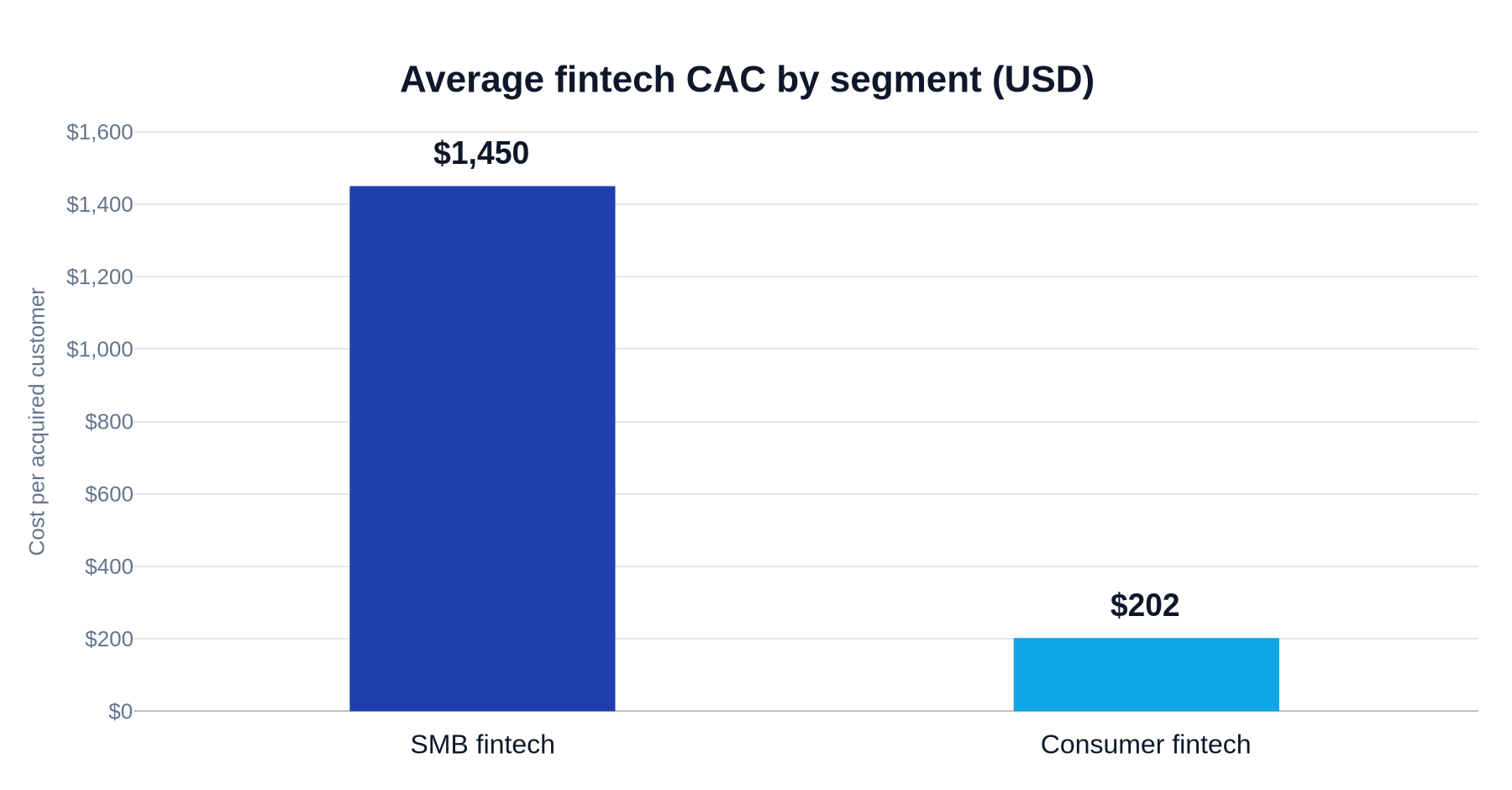
- Any acquisition model anchored to sign-up cost alone understates the cost of an activated user. SMB-focused fintech CAC averages $1,450 per customer, versus $202 in consumer segments (First Page Sage).
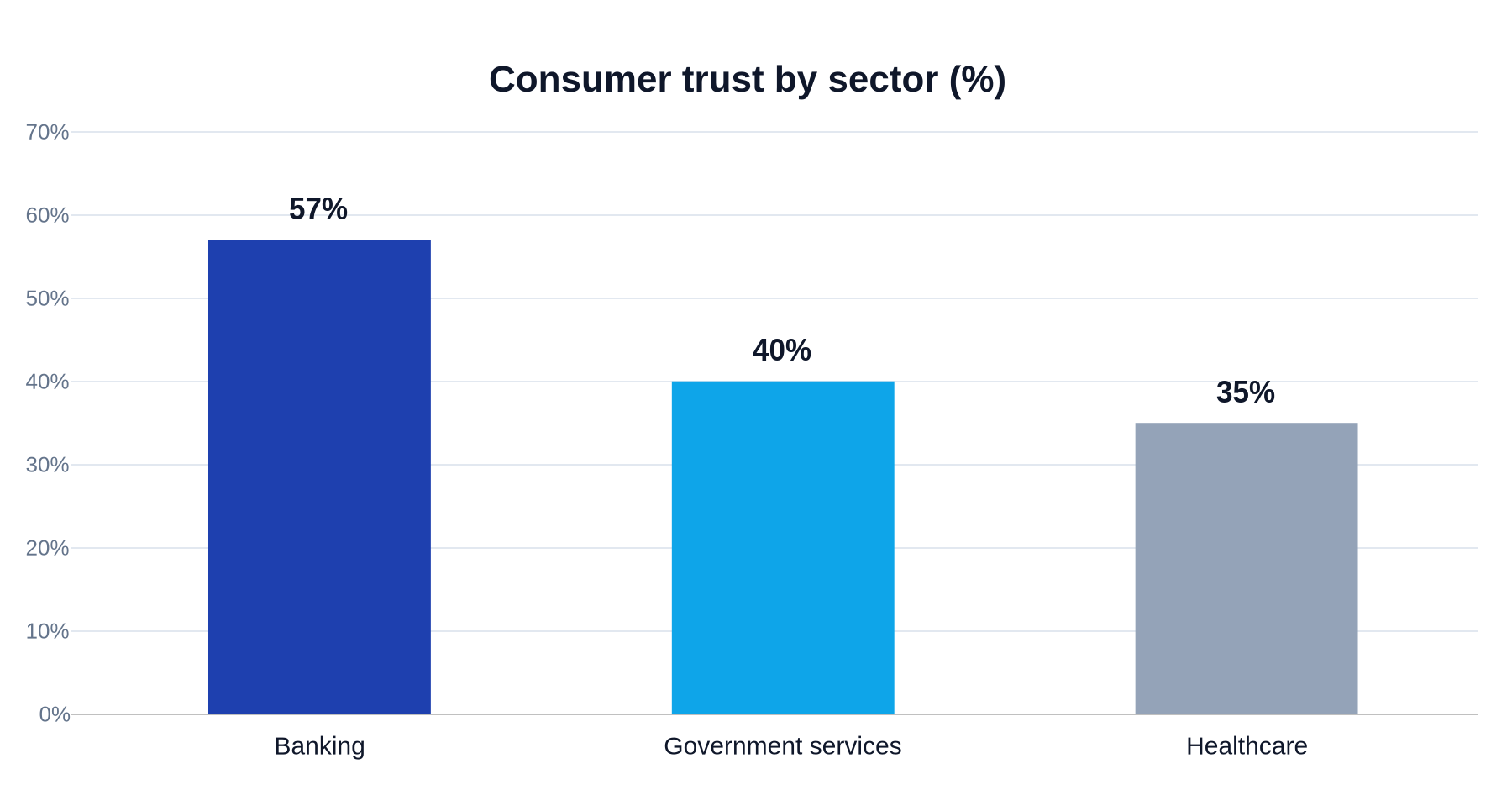
- Banking is the most trusted digital sector at 57%, ahead of government services at 40% (Thales Digital Trust Index, 2026). This trust belongs to the category.
- Organizations are known to have reached a million customers without much meaningful paid media.
Table of Contents
- What is fintech marketing, and why is it not financial services marketing?
- The growth paradox: shipping fast inside a regulated product
- The fintech funnel does not end at sign-up
- Product-led growth and referral loops: Fintech's native motion
- Sub-vertical playbooks: the tactic depends on the product
- The fintech marketing metrics that matter
- What should a fintech marketing agency do?
- The Bottom Line on Fintech Marketing
- FAQs
Fintech marketing has two clocks running at different speeds. The product team ships weekly, while compliance moves at banking pace. Many of the growth failures are actually timing failures: a campaign built in isolation, then handed to legal three days prior to launch.
The global fintech market reaches $460.76 billion in 2026, up from $394.88 billion in 2025, on an 18.2% compound growth rate (Fortune Business Insights, 2026). That scale fetches capital, rivals, and an audience which has seen sufficient spectacular collapses to be already suspicious.
Here is the playbook by sub-vertical: how fintech marketing differs, why the funnel breaks at the point where it does, which acquisition motion suits each category, and the three numbers worth managing against.
What is fintech marketing, and why is it not financial services marketing?
Fintech marketing is the practice of acquiring and retaining users for technology-native financial products (neobanks, payment platforms, crypto exchanges, WealthTech apps, B2B embedded finance tools) within a regulatory environment that restricts what you can claim, on which platforms, and with what disclosures attached.
Established categories like savings accounts, mortgages and insurance get sold to buyers who already grasp the underlying proposition. Fintech marketing must sell a behaviour change first: leaving an incumbent whose logo has hung above a high street since before the buyer was born.
The trust data makes the distinction concrete. Banking ranks as the most trusted digital sector at 57%, ahead of government services at 40% and healthcare at 35%, across 15,000+ respondents in 13 industries (Thales Digital Trust Index, March 2026). The figure describes the category, not an individual brand inside it, and a challenger inherits none of it automatically.
In other words, fintech marketing shoulders a double burden. It needs to establish that the product type is safe, then demonstrate its version is the right one, and finish both before any conversion conversation opens. That is the defining constraint of the discipline, and it is why a fintech marketing strategy that borrows wholesale from SaaS tends to underperform.
The growth paradox: shipping fast inside a regulated product
A SaaS startup can launch a free tier, run forty experiments monthly, and rewrite its value proposition each quarter with no legality involved. This cannot be done by fintech teams. Every marketing claim is a regulated statement, and risk disclosures are mandatory in most jurisdictions. Further, Google, Meta, and TikTok then stack their own advertising policies on top of local law, usually stricter than the law.
The outcome is a paradox: engineering velocity at startup tempo and messaging velocity at banking tempo.
Teams that solve it operate compliance and marketing as parallel functions sharing one brief. Across the campaigns that we deliver at Clickeon for regulated fintech brands, the fastest-scaling work shares a single pattern without exception: Compliance is in the same room while the message gets built.
My rule: If legal is discovering the proposition for the first time, you have already surrendered a fortnight no one gets back.
The fintech funnel does not end at sign-up
Traditional marketing funnels close at sign-up. But in fintech, sign-up is the starting line.
As the sequence runs sign-up → KYC and identity verification → activation → first use → habit, each stage sheds people, and the KYC checkpoint sheds the largest share. Signicat's research across 7,600 consumers in Europe found 68% had abandoned a financial services application in 2022, up from 63% in 2020 and the worst result since the study began in 2016. Abandonment happens after an average of 18 minutes and 53 seconds, down from 26 minutes (Signicat, The Battle to Onboard, 2022).

Marketing cannot repair a broken onboarding flow, but can achieve something cheaper: calibrate expectations before anyone reaches verification. Naming the documents required and the realistic approval window removes nearly all the unpleasant surprise behind that eighteen-minute walk-away.
This funnel shape is also why fintech customer acquisition cost is so routinely misread. SMB-focused fintech CAC averages $1,450, against $202 for consumer segments (First Page Sage, 2025). These are sign-up costs. Run your own drop-off rate against them and the price of an activated revenue-generating user becomes a materially different figure, often more than double. Models anchored to sign-up cost optimise something that doesn't pay you, and the error compounds with every extra dollar of spend.
Product-led growth and referral loops: Fintech's native motion
Product-led growth treats the app itself as the primary acquisition channel than a retention tool. Within fintech specifically, it delivers the strongest CAC efficiency on record, because distribution gets engineered in instead of being purchased.
Monzo is the clearest documented case. Co-founder Tom Blomfield has written that the bank reached its first million customers "without having spent any significant money on marketing." Its Golden Tickets referral feature drove "about 40% of our signups in 2017, and it cost us nothing" (Tom Blomfield, Monzo Growth). Before that, a capped 3,000-user alpha and a 20,000-strong waiting list did the work that a media budget would otherwise have done.
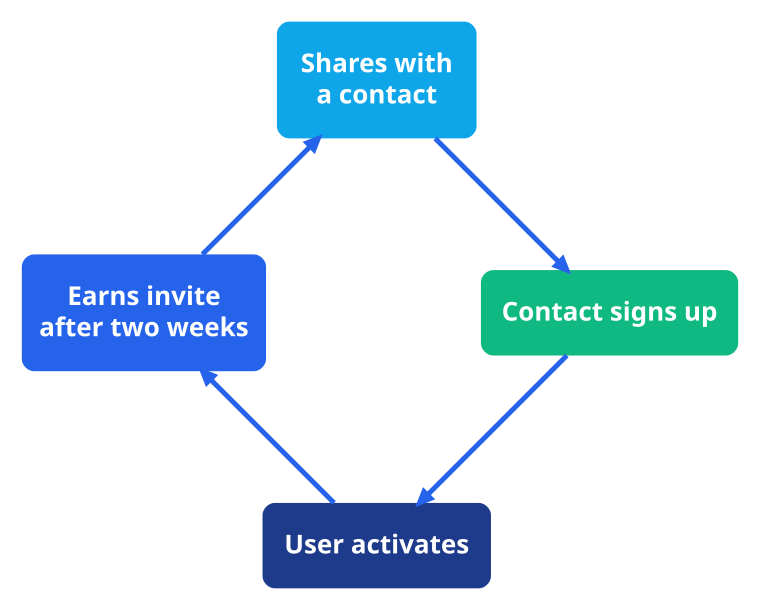
Three consumer patterns recur:
- Referral mechanics: Time-limited reward offers, as Revolut ran, or a transparent fee comparison that hands the user a concrete argument for switching, as Wise built.
- P2P network effects: A payment app becomes more useful with every contact who joins, so utility and acquisition are the same curve.
- In-app sharing: Turning a product moment into organic reach rather than manufacturing a campaign around it.
B2B fintech marketing runs the same logic through different plumbing. Angela Strange, general partner at Andreessen Horowitz, framed the category thesis in 2020:
"In the not-too-distant future, I believe nearly every company will derive a significant portion of its revenue from financial services."
- Angela Strange, General Partner, Andreessen Horowitz (a16z, January 2020)
The API-first companies building toward that reality win on developer-first distribution: free-tier API access, documentation that ranks in search, and sandbox environments that replace the sales demo. Notice that two of these three are fintech SEO problems donning an engineering hat.
Sub-vertical playbooks: the tactic depends on the product
Which channel should a crypto exchange prioritise that a neobank should not? The answer changes by product type, and several fintech marketing failures trace back to using the wrong vertical's playbook. The table below reflects how we segment the four major sub-verticals in client work:
| Sub-vertical | Primary acquisition channel | Key trust signal | Critical metric |
|---|---|---|---|
| Neobank/ challenger bank | Referral plus social, paid and organic | Deposit protection, regulatory licence | Activation rate |
| B2B embedded finance/ API | Developer docs, SEO, events | SOC 2, uptime SLA | API integration rate |
| Crypto/ Web3 | Community (Discord, X, Telegram) | Security audit, proof of reserves | DAU/MAU ratio |
| WealthTech/ trading apps | Content SEO, comparison sites, paid search | Regulatory registration, track record | AUM per user |
The community motion in crypto deserves a specific note. A 2023 Bankrate survey found 30% of Americans had used social media for financial advice, rising to 76% of Gen Z and 65% of millennials (Philadelphia Fed, 2025). For crypto and Web3 audiences, Discord and Telegram are the primary research environments, and members who feel ownership of a project become distribution, front-line support, and trust signal simultaneously. No paid channel can reproduce that.
Neobank marketing has its own record. Revolut, Monzo and Wise - each built their early base through referral, PR and word of mouth rather than media weight. Wise's fee calculator is the sharpest example, because it did not explain the product so much as hand every user a shareable argument for leaving their bank.
The fintech marketing metrics that matter
Cost per click, click-through rate, and impressions measure channel activity. They tell you nearly nothing about whether a fintech business is compounding. The following three numbers do:
Activation rate: The share of sign-ups completing the first revenue-generating action: a funded account, a processed payment, an executed trade. Given the abandonment data above, this is generally the number with the most upside in the whole business. Improving it lowers effective CAC, lifts Day-30 retention, and shortens payback, for a fraction of what high traffic costs.
LTV: CAC ratio: Operators and investors converge on 3:1 as the floor and 4:1 as the healthy target. Below 3:1, acquisition burns capital faster than it compounds. This is a widely used operating convention rather than a published benchmark, so see it as a decision rule.
CAC payback period: This tells how long revenue takes to recover acquisition cost. It helps you decide whether to accelerate spend or hold, which is why it dominates operator dashboards. We build attribution models that report payback by channel for this reason: cost per click will happily tell you a channel is cheap while it quietly fails to pay for itself.
Context for all three: Digital payments alone are projected at US$37.45 trillion in total transaction value in 2026 (Statista, 2026). Juniper Research forecast back in 2021 that 53% of the world's population, over 4.2 billion people, would use digital banking by 2026, up from 2.5 billion in 2021 (Juniper Research, 2021). So, the constraint here is unit economics, not addressable market.
What should a fintech marketing agency do?
A fintech marketing agency earns its fee on three things that a generalist cannot do well.
Own the compliance layer: Knowing which claims are permissible by jurisdiction and by platform, before creative is built, so review accelerates campaigns instead of stalling them.
Bring sub-vertical channel and funnel expertise: A neobank brief and a B2B embedded-finance brief share a category and nearly nothing else. An agency that perceives them the same will get one of them wrong.
Build attribution that reaches past sign-up: Awareness through activation through payback period, by channel. Without it, every budget decision is a guess shown as a report.
That is the remit we work to. Clickeon covers GTM strategy, fintech SEO, performance marketing, martech, and lifecycle attribution for regulated brands across forex, crypto, payments, and B2B platforms. The full stack can be viewed on our fintech marketing services and industries pages, with outcomes in our case studies.
The Bottom Line on Fintech Marketing
Fintech marketing in 2026 rewards precision over volume. As the market is large and growing at 18.2% a year, it implies that the competition is well funded and the buyer is well-informed. Neither condition can be fixed by spending more.
The brands taking share do three things consistently: They treat sign-up as the middle of the funnel. They build distribution into the product before scaling paid. They run the business on activation rate and payback period, not channel vanity metrics. This is what the unit economics of a regulated and high-CAC category demand. If you want a second read on your own funnel, contact our team that works with regulated fintech brands across more than 30 markets.
FAQs
What is the difference between fintech marketing and financial services marketing?
Financial services marketing promotes established and trusted categories such as savings accounts, mortgages and insurance, to audiences who already understand the product type. Fintech marketing has to sell a behaviour change: moving from a known provider to a challenger with a shorter track record. Banking as a category is the most trusted digital sector at 57% (Thales, 2026), but that trust belongs to the category, not to a new entrant by default. The difference is in the audience, trust-building requirement, funnel structure, and compliance obligations.
Why is fintech customer acquisition cost so often understated?
Because the reported figure is usually the cost per sign-up, and sign-up is not the point at which a fintech user starts generating revenue. SMB fintech CAC averages $1,450, and consumer averages $202 (First Page Sage, 2025), but these users still have to clear KYC and reach activation. With 68% of consumers abandoning financial applications during onboarding (Signicat), the cost of an activated user can run well beyond double the headline number.
What is product-led growth and how do fintech companies use it?
Product-led growth makes the product the primary acquisition channel rather than a retention tool. In consumer fintech, this means referral programmes, P2P network effects and in-app sharing. In B2B fintech marketing, it usually entails free-tier API access, searchable documentation, and sandbox environments that let a buyer assess before speaking to sales. The common thread is that distribution is engineered into the product before media budget is deployed.
How did neobanks acquire their first million users?
Through referral, PR, and word of mouth rather than paid acquisition. Monzo used a capped alpha and a 20,000-person waiting list to manufacture scarcity, then a referral feature that drove roughly 40% of its 2017 sign-ups at zero cost. It reached a million customers without significant marketing spend. Wise turned fee transparency into a shareable switching argument. Revolut used time-limited referral rewards for urgency. In all three cases, distribution lay inside the product first.
Which marketing channel works best for a crypto exchange?
Community works the best. Discord, Telegram, and X are the primary research environments for crypto and Web3 audiences, and 30% of Americans (76% of Gen Z) have used social media for financial advice (Philadelphia Fed). The trust signals that hold in this vertical are security audits and proof of reserves, which are established in community discussion rather than in ad creative. The critical metric is the DAU/MAU ratio.
Do we need a specialist fintech marketing agency?
Not necessarily, but three capabilities are surely worth testing for. Can they handle the compliance layer without slowing every campaign? Do they adjust the playbook by sub-vertical rather than applying one template? Does their attribution reach past sign-up to activation and payback period? Ask a prospective partner to walk you through how they would handle a KYC-stage drop-off problem. Their answer tells you whether they understand the category or merely the channels.
This article is informational only and does not constitute financial, legal or compliance advice. Regulatory obligations vary by jurisdiction and change over time. Consult a qualified compliance professional before acting on anything here.