
Key Takeaways
- Crypto buyers are now mainstream, so the tone that worked in the last cycle does not work anymore.
- Trust beats hype. It is said publicly by the head of marketing of the largest exchange.
- Compliance is no longer optional in Europe. The grace period for EU crypto firms ended on 1 July 2026.
- Write for AI answers as well as Google, because more people now get an answer without ever clicking.
- Build in order: foundation, community, content, paid. Skipping a step makes every step cost more later.
- Measure holding and repeat activity on-chain, not by followers.
Table of Contents
- What Is a Crypto Marketing Strategy?
- Why Trust Now Beats Hype?
- Layer One: Positioning, Audience and Compliance
- Layer Two: Community Management on Discord, Telegram and KOC Networks
- Layer Three: Content That Google Ranks and AI Systems Quote
- Layer Four: Paid Reach, KOLs and Exchange Listings
- PR, Events, and Referral Programmes
- What to Measure in a Crypto Marketing Strategy
- Common Crypto Marketing Mistakes
- The Bottom Line on Crypto Marketing Strategy
- Frequently Asked Questions About Crypto Marketing Strategy
A crypto marketing strategy that works in 2026 has to do two things, unlike a 2021 playbook. It has to earn trust from ordinary people, and it has to get quoted by AI systems that answer questions before anyone clicks a link.
The audience has changed, and so have the systems. Global crypto ownership reached 741 million people at the end of 2025, up 12.4% in a year (Crypto.com Report, 2025). Instead of a niche of early speculators, it is a mainstream consumer group now that responds to proof rather than noise.
This article walks through the strategy in the order we would build it for a client. Beginning with the foundation, it would then proceed to community, content, and paid reach, in that order.
What Is a Crypto Marketing Strategy?
A crypto marketing strategy is the plan a project uses to build awareness and adoption for a token, an exchange, or a Web3 protocol. Web3 marketing is the same discipline under a different name, and the plan is the same whether you are running a token launch marketing push or growing an existing protocol. It works across four connected layers: positioning and compliance, community, content and search visibility, and paid or influencer reach.
The difference from marketing a normal app or financial product is the trust gap. A consumer bank starts with decades of brand recognition, deposit protection, and a regulator standing behind it. A new token has none of that at the start. Community proof, open communication, and visible on-chain activity have to do the job that a familiar logo would otherwise do.
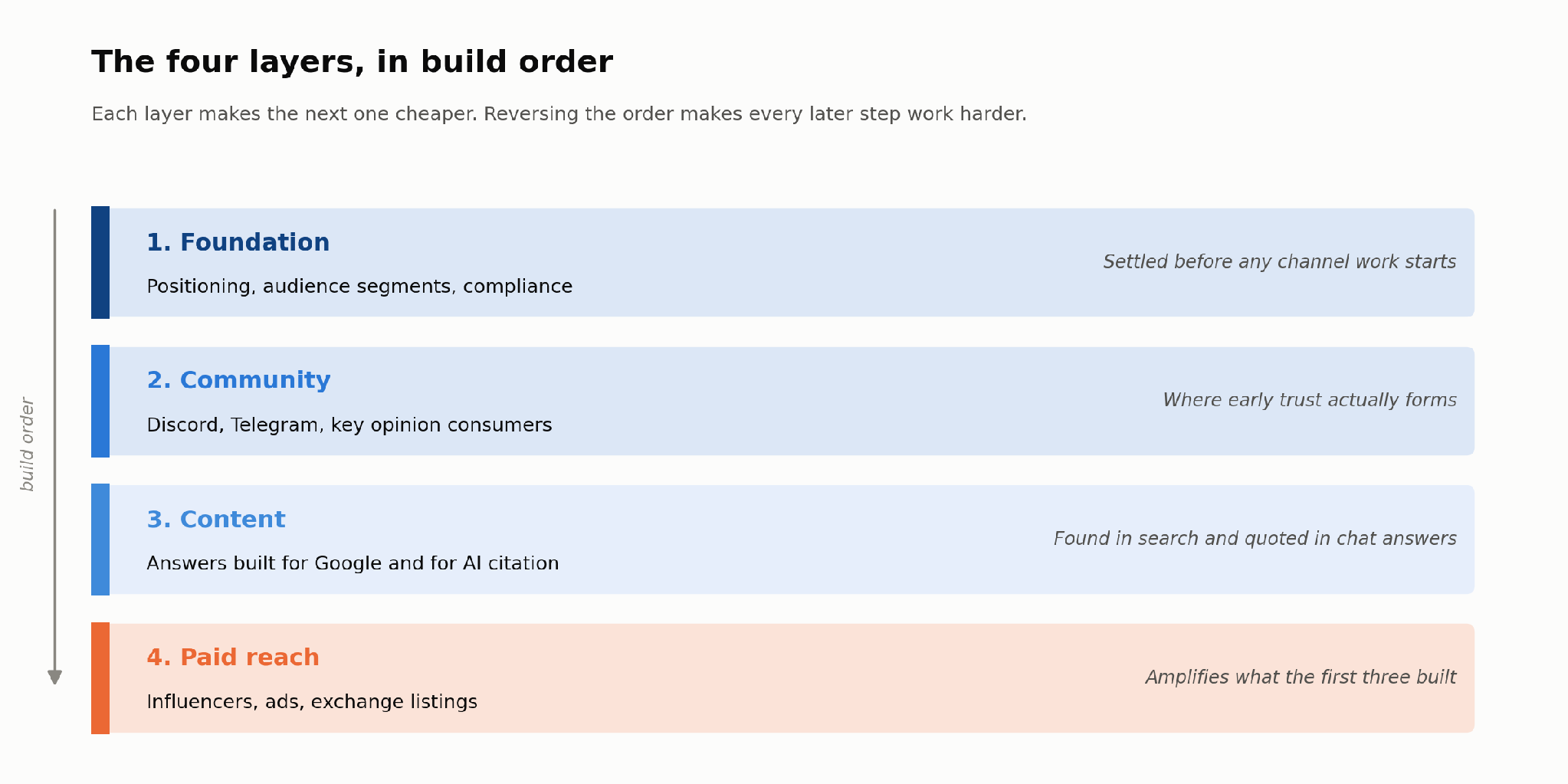
The four layers are as follows:
- Foundation: Positioning, audience segments, and compliance, settled before any channel work.
- Community: Early trust actually forms on platforms like Discord, Telegram, and smaller networks of everyday users.
- Content: Publishing created to be found by Google and quoted in AI answers.
- Paid reach: Influencer partnerships, ads, and exchange listings that amplify the work of the first three layers.
If you skip the foundation, the other three cost more and convert worse. We see this often in early client audits. A team has spent five figures on influencer campaigns pointed at a project without a clear compliance story or well-defined audience. The money bought attention, but did not give anyone a reason to stay.
Why Trust Now Beats Hype?
The most credible people in crypto marketing now say openly what smaller projects are slow to admit: Hype-first campaigns buy attention without retention.
Eowyn Chen, interim chief marketing officer at Binance, put it plainly in July 2026. Trust is earned "through transparency, participation, and community, not through broadcast" (CoinGape, 2026). Coming from the marketing lead at the largest exchange in the industry, that is a break from the growth-at-any-cost tone of the last cycle. It is the same idea our team works from when building campaigns for forex and crypto brands.
Here is a practical example of it: A paid campaign can buy you attention for a week. But it cannot buy the participation that makes a community defend a project when something goes wrong. It also cannot buy the on-chain activity that shows a token is used for something other than speculation.
However, hype tactics have not disappeared, and they should not. Airdrops, contests, and headline partnerships still belong in a healthy mix. The change is primarily in the order. Today, they work as amplifiers of something already credible. A giveaway aimed at an engaged community converts very differently from the same giveaway aimed at people who showed up for free tokens and no real use case.
Layer One: Positioning, Audience and Compliance
Positioning answers this question: Who is this token or platform for, and what can they do with it that they could not do before?
A lending protocol, a gaming token, and a Layer-2 network - all need different messages, different channels, and different proof. Treating "crypto users" as one audience is the most common foundational mistake we see in early client work.
Split the audience into at least three groups:
You must do this before writing any copy.
- Active traders want yield or price movement. They are present on X and Telegram.
- Builders and technical users are judging the protocol itself. They read documentation and technical Discord channels.
- Newer buyers need the "why does this matter" explanation first. They search on Google or ask an AI assistant as a primary step.
Each group needs its own content. One common message stretched across all three doesn't land with any of them.
MiCA Marketing Compliance Comes Before the Campaign
This is the part that changed most of the work in 2026.
In the EU, the transitional period under MiCA, the Markets in Crypto-Assets regulation, ended on 1 July 2026. Firms that had been operating under older national rules lost the protection. They either have an authorisation as a crypto-asset service provider or they stop serving EU customers (InnReg, 2026). If your plan assumes a grace period, it needs rewriting.
MiCA also sets rules for the marketing itself. Under Article 7, a marketing communication has to be clearly identifiable as marketing, must be fair and clear without misleading, and must match what the white paper says. It also has to carry a statement that no EU authority has reviewed or approved it, and it must be available to the regulator on request (goMiCA). A white paper here is the disclosure document a project publishes about the token itself.
None of this needs a long legal process. A short checklist catches most of the risk before any ad goes live: What can we claim about returns? What can we say about our regulatory status? Which countries need a different disclaimer?
This is where our positioning and compliance work starts for a new crypto client, prior to any channel work.
Layer Two: Community Management on Discord, Telegram and KOC Networks
Community is where a project earns the trust that paid channels can only amplify. Discord and Telegram are still the two main hubs. They have different purposes, and many projects are better off running both than picking one.
| Discord | Telegram | |
|---|---|---|
| Best for | Structured community, role-based access, technical discussion | Fast broadcast, large announcements, trading chatter |
| Typical use | Governance discussion, support channels, builder community | Price talk, news, regional and language groups |
| Moderation load | Higher, because the channel structure needs active curation | Lower, flatter and faster-moving |
| Suits | Protocols, DAOs, projects with a technical audience | Tokens with broad retail interest and fast campaigns |
Beyond those two platforms, key opinion consumers are becoming more valuable than a single big influencer post. A key opinion consumer, or KOC, is a smaller community member with genuine engagement, without paid reach. Someone who actually uses a protocol and talks about it unprompted carries more weight with a sceptical audience than a sponsored thread from an account that joined the server recently.
The practical point on crypto community management is budget. See it as your key operating cost. Accordingly, you can:
- Cover the time zones your users are in.
- Hire real moderators instead of leaning on one overworked founder.
- Have a clear path for handling problems.
These three things do more for retention than almost any paid campaign running alongside them. And a community that feels heard during a bad week is a community that stays for the next good one.
Layer Three: Content That Google Ranks and AI Systems Quote
Crypto content marketing in 2026 has to fulfil two systems simultaneously: A search crawler and a language model deciding what to quote in a conversational answer.
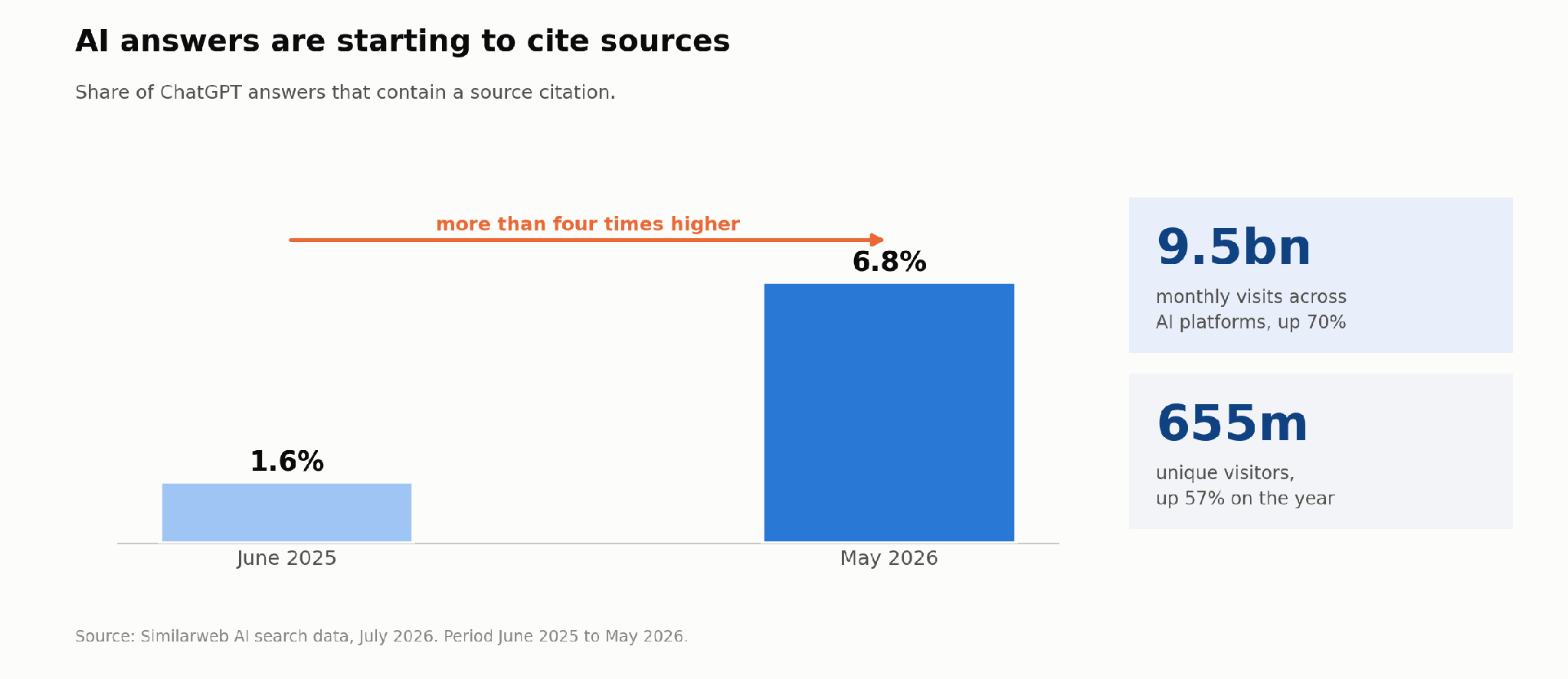
Monthly visits across generative AI platforms reached 9.5 billion in a year, from June 2025 to May 2026, up by 70%, with 655 million unique visitors (Similarweb, 2026). Further, the share of ChatGPT answers that cite a source increased from about 1.6% in June 2025 to almost 6.8% by May 2026. Citations are becoming an actual distribution channel, and they go to pages built to be quoted.
The good news is that these two goals usually agree. Content that answers a specific question directly, in a self-contained paragraph, tends to rank well in Google and gets quoted by AI systems for the same reason. It is useful on its own, without the reader having to assemble the answer from surrounding text. So, you must lead every section with the direct answer, and then explain the reasoning. That serves both the systems.
Crypto content has a few extra points to plan for:
- Educational over promotional: The content that answers the questions your community keeps asking in Discord outperforms promotional posts, both for rankings and for building the topical authority that gets a domain seen as a trustworthy source.
- Publish consistently, instead of one launch burst: Glossary explainers, honest comparisons, and direct answers to the objections that users raise must be released steadily.
- Show who wrote it: A named team, a visible track record, and citations to real data convey to Google and AI crawlers that the content comes from actual people who know the space. AI search visibility rests on the same indicators that earn a human reader's trust.
Layer Four: Paid Reach, KOLs and Exchange Listings
Paid reach works best as an amplifier for a story that is already credible. And influencer partnerships are still one of the higher-return channels available, but only when the influencer's audience overlaps with your segments.
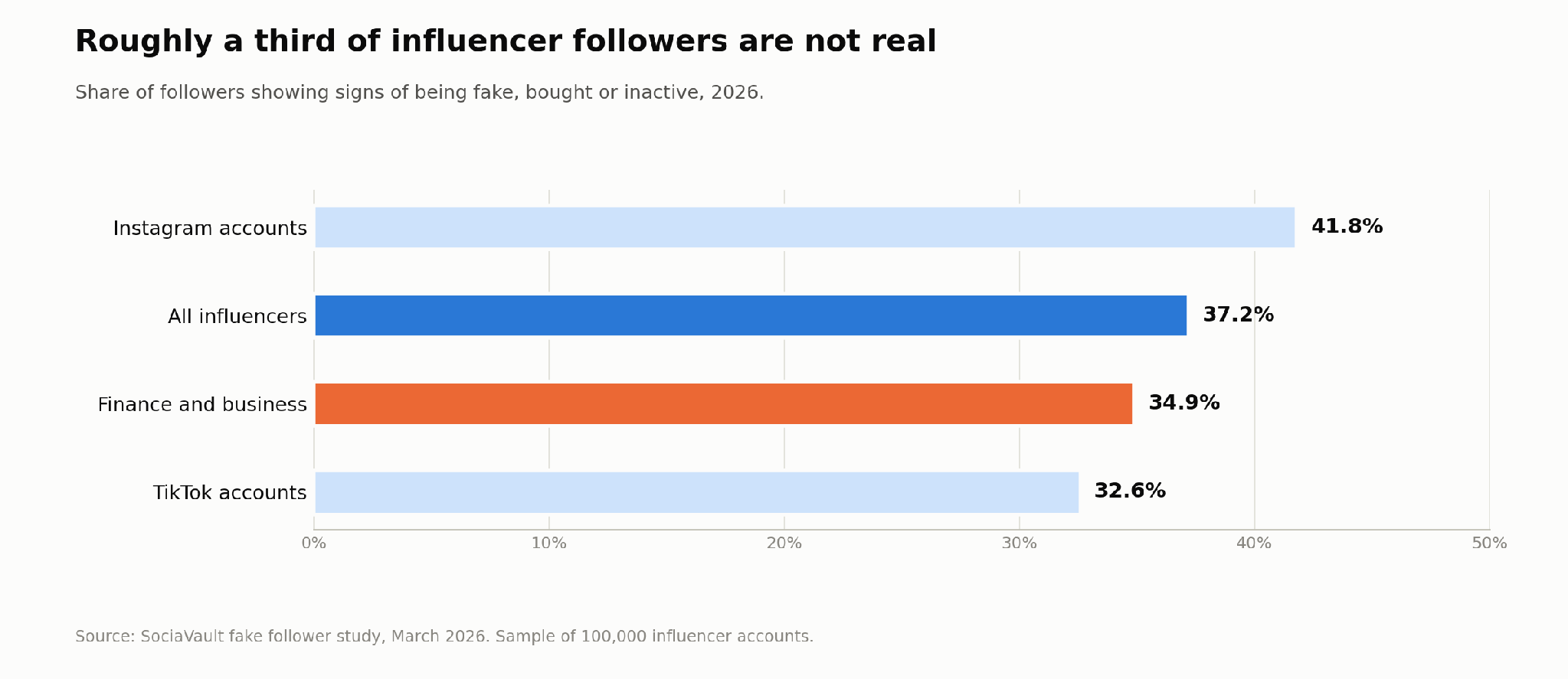
The gap between a KOL's follower count and their real audience is the most common way crypto marketing budgets get wasted. A KOL, or key opinion leader, is a paid influencer with huge reach. Across 100,000 influencer accounts studied in early 2026, 37.2% of followers showed signs of being fake, bought, or inactive. Even in the finance and business category, which scored better than most, the rate was 34.9% (SociaVault, 2026).
In other words, crypto influencer marketing starts with an audit of engagement quality. When we scope crypto KOL marketing for a client, we look at actual comment threads, a consistent posting history, and whether the past partnerships were disclosed. All these point to an audience that trusts the account. A smaller influencer with an engaged and relevant audience beats a much larger account padded with bots and giveaway hunters who leave when the incentive ends.
Exchange listings work as a credibility channel more than a marketing line. A listing on a reputable exchange indicates a level of due diligence that no amount of paid promotion can replicate. Yet, order matters here too. A listing announced to a community that is already engaged converts quite differently from the same announcement dropped on an audience that is unaware of the project.
Paid ads and direct outreach still belong in the mix, but as accelerators. If directed towards a project with no community or content behind it, they speed up the discovery that there is nothing in it.
PR, Events, and Referral Programmes
Public relations in crypto works differently from other industries. A placement in a major crypto publication does more to establish you with exchanges and institutional partners than it does to drive retail sign-ups. If you see press as a credibility signal aimed at partners and listing committees, expectations get realistic quickly.
Referral and affiliate programmes are better ways to acquire users, because the person referring has already vouched for you. The strongest programmes reward actual participation rather than just a wallet connect. So, you must structure rewards to unlock over time, or to grow with continued activity, instead of paying out in full for a one-time signup that may not return.
Conferences are more crucial for relationships and partnership pipeline than for direct user acquisition. If you treat an event sponsorship as a lead channel with a great return number, it will disappoint. The return usually shows up months later, in a partnership or a listing conversation that started with a face-to-face chat.
These three rarely impact on their own the way community and content do. They earn their budget through compounding. For instance, a referral programme backed by a healthy community converts better than the same programme launched cold. A press placement lands better when the reporter can point to an active community as proof the project is more than a press release with a token attached.
What to Measure in a Crypto Marketing Strategy
It's definitely not follower counts or total number of Discord members. You must track what predicts whether users stay and do something with the token.
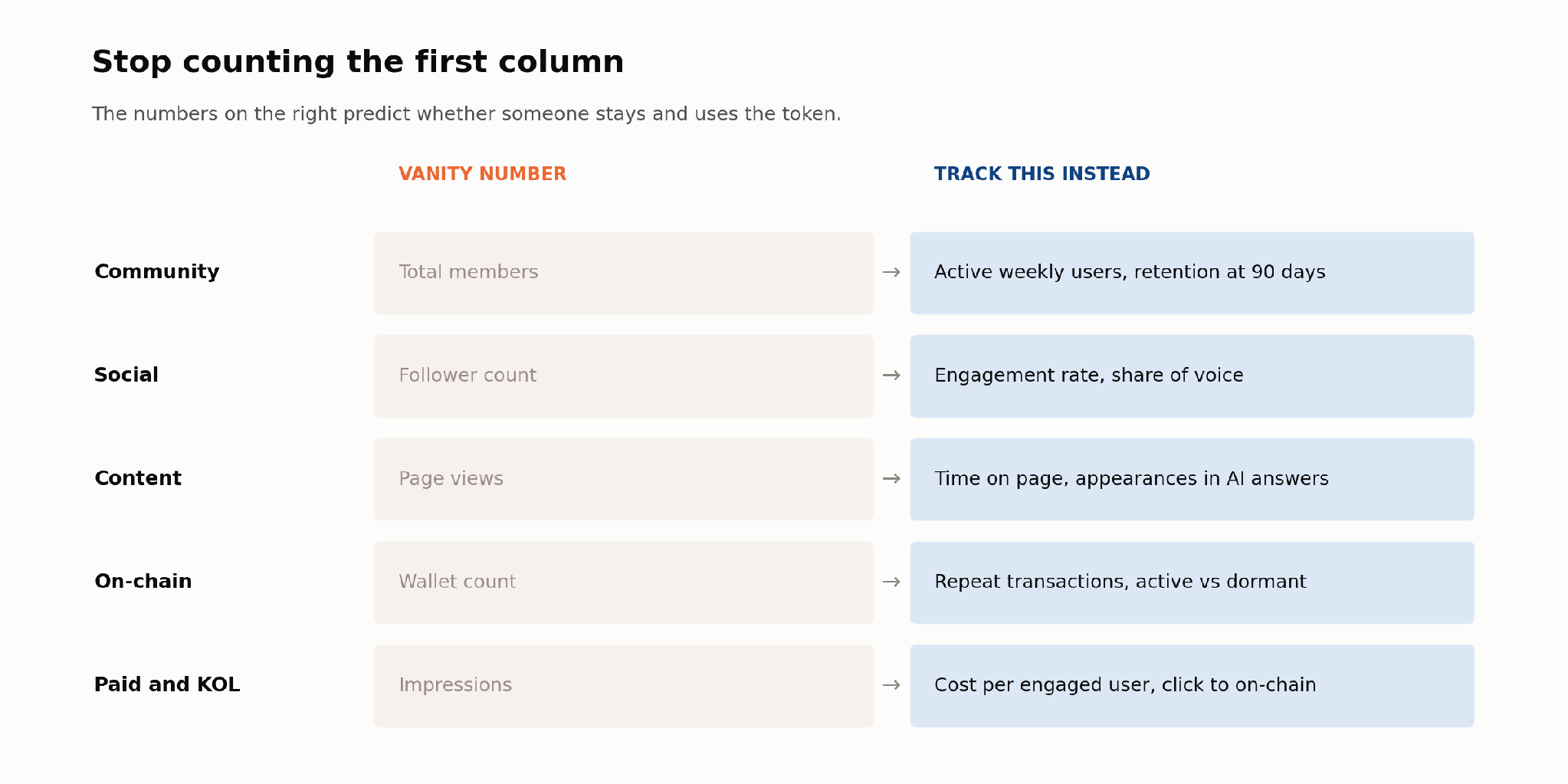
| Area | Vanity number to avoid | Must Track |
|---|---|---|
| Community | Total Discord or Telegram members | Active weekly participants, retention at 30, 60 and 90 days |
| Social | Follower count | Engagement rate on your own content, share of voice against named competitors |
| Content | Page views alone | Time on page, appearances in AI answers, rankings for target questions |
| On-chain | Wallet count | Repeat transaction rate, holder concentration, active against dormant wallets |
| Paid and KOL | Impressions | Cost per genuinely engaged user, clicks that turn into on-chain activity |
On-chain data is crypto marketing's advantage over other industries. You can check whether a campaign drove holding, staking, or transactions, rather than simply trusting a platform's own impression count. Projects that add this into weekly reporting from the start spot a failing channel much before teams watching social numbers notice anything.
A project with strong holder retention but no new wallets has a different problem from the one with fast new-user growth and weak retention.
Common Crypto Marketing Mistakes
Most of the failures can be traced back to a few repeatable mistakes.
Treating community size as community health: A server listing tens of thousands of members but drawing only a few hundred into a weekly conversation is not a healthy community, no matter what the headline number suggests to an outside investor.
Launching paid and KOL campaigns before the foundation is done: We see this most in projects that hired an influencer agency before deciding who the token is for. A well-funded launch aimed at unclear positioning produces a spike in attention and then a faster drop-off, because the traffic arrives without any reason to stay.
Writing only for search engines: Content stuffed with keywords but light on clear self-contained answers now ranks worse than it used to and gets ignored by AI systems. This misses the fastest-growing part of the funnel.
Assuming the old EU rules still apply: The MiCA grace period ended on 1 July 2026. If you have written any plan before that, you must check it before implementation.
The fix for the first three is the same ordering problem: Foundation before community, Community before content, and Content before paid. Each layer makes the next one cheaper.
The Bottom Line on Crypto Marketing Strategy
A crypto marketing strategy that holds up in 2026 is built in one order: foundation, community, content, then paid reach. It measures success through retention and on-chain activity rather than follower counts. And it views compliance as an input to the brief rather than a check before launch.
The projects still working after the last cycle are, almost without exception, the ones that built trust before they bought attention. If you are planning a token launch or working on a protocol that has plateaued, the order matters more than any single tactic above. Our team does this kind of growth planning with forex, crypto, and fintech brands. If you would rather talk it through than build it alone, book a consultation.
Frequently Asked Questions About Crypto Marketing Strategy
What is crypto marketing in simple terms?
Crypto marketing is building awareness, trust, and adoption for a token, exchange, or Web3 protocol. It combines normal digital marketing, meaning content, search, and paid ads, with crypto-specific mechanics like community incentives, airdrops, and on-chain proof that people are using the product.
How much does a crypto marketing strategy cost?
It varies widely by stage and ambition. A small community-first launch might run a few thousand dollars a month, whereas a well-funded exchange or Layer-1 campaign can reach seven figures. Community management alone typically runs from a few thousand dollars a month for part-time cover, up to five figures for round-the-clock moderation in several languages.
Should a new token prioritise Discord or Telegram?
Usually, projects should run both, because they serve different purposes. Discord suits structured, technical communities that need governance discussion, role-based access, and support channels. Telegram is for fast broadcast, trading chatter, and large announcements. You can pick your main hub based on whether your core audience is technical or trading-focused, then treat the second platform as a supporting channel rather than an equal priority at the start.
Is crypto marketing regulated?
Yes, and more so than in previous years. In the EU, MiCA establishes rules for marketing communications. They must be identifiable as marketing, should be fair and consistent with the white paper, and carry a statement that no authority has approved them. The transitional period for firms on older national rules terminated on 1 July 2026. Elsewhere, claims about returns or investment potential can trigger securities and advertising rules even when the project is decentralised.
How do I avoid paying a crypto influencer for fake followers?
For that, you must check engagement quality before reach. Look for real comment threads rather than one-word replies, a consistent posting history rather than a burst of activity, and disclosed past partnerships. A 2026 study of 100,000 influencer accounts found 37.2% of followers showed signs of being fake or inactive, so the check is a must before signing a paid deal.
How long does crypto marketing take to show results?
Community growth and early engagement can move within weeks. The key numbers that, like retention, repeat on-chain activity, and organic rankings, usually take three to six months to show a reliable trend. Content and search compound slowly at first, then speed up once the domain builds authority on a topic.
This article is strategic marketing guidance, not legal, tax, or investment advice. Rules vary by country and should be reviewed by qualified counsel before launch.