
Key Takeaways
- Sign-ups no longer prove your marketing is working. Account numbers held flat in 2026 while trading per account fell.
- Many new traders stop trading before they ever earn the broker any money.
- Now, regulators decide what your ads can say. Deposit bonuses are banned in the EU, UK, and Australia.
- You are responsible for what your affiliates post, the same as for your own ads.
- Judge your partners by how many of their referrals are trading even after three months, not how many signed up.
- Expect to spend around $600 in marketing for each client who opens an account and deposits.
Table of Contents
- Why New Accounts No Longer Mean More Trading
- CFD Marketing Compliance Writes the First Draft of Your Brief
- How to Build a Forex Marketing Strategy Targeting Active Traders
- What Trader Acquisition Costs in 2026
- Common Mistakes That Waste Forex Marketing Budget
- The Bottom Line on Forex Marketing Strategy
- Frequently Asked Questions
A forex marketing strategy that counts sign-ups as progress is measuring the wrong parameter. While brokers report funded accounts and first deposits as wins, the second quarter of 2026 revealed something else. The brokers tracked by Finance Magnates Intelligence held about 7.39 million active client accounts, almost the same as the quarter before, and yet the amount each of those accounts traded per month dropped (Finance Magnates, 2026). The client numbers held steady, but the trading behind them fell.
This article is about understanding how to close this gap. A forex broker marketing strategy has to answer three questions: What counts as a win, what the rules allow, and what an active trader costs.
Why New Accounts No Longer Mean More Trading
A funded account is where someone signed up and put money in, whereas an active account is one where someone is actually trading. Earlier, these two things used to move together in number, but not anymore.
Account numbers rose in each of the four quarters up to Q1 2026, reaching 7.42 million. This was a 42% rise on the year before (Finance Magnates, 2026). But in Q2 2026, the account count barely moved. But the typical account traded 9.7% less, dropping to $3.06 million a month. Trading per account fell at 45 of the 51 brokers tracked across both quarters.
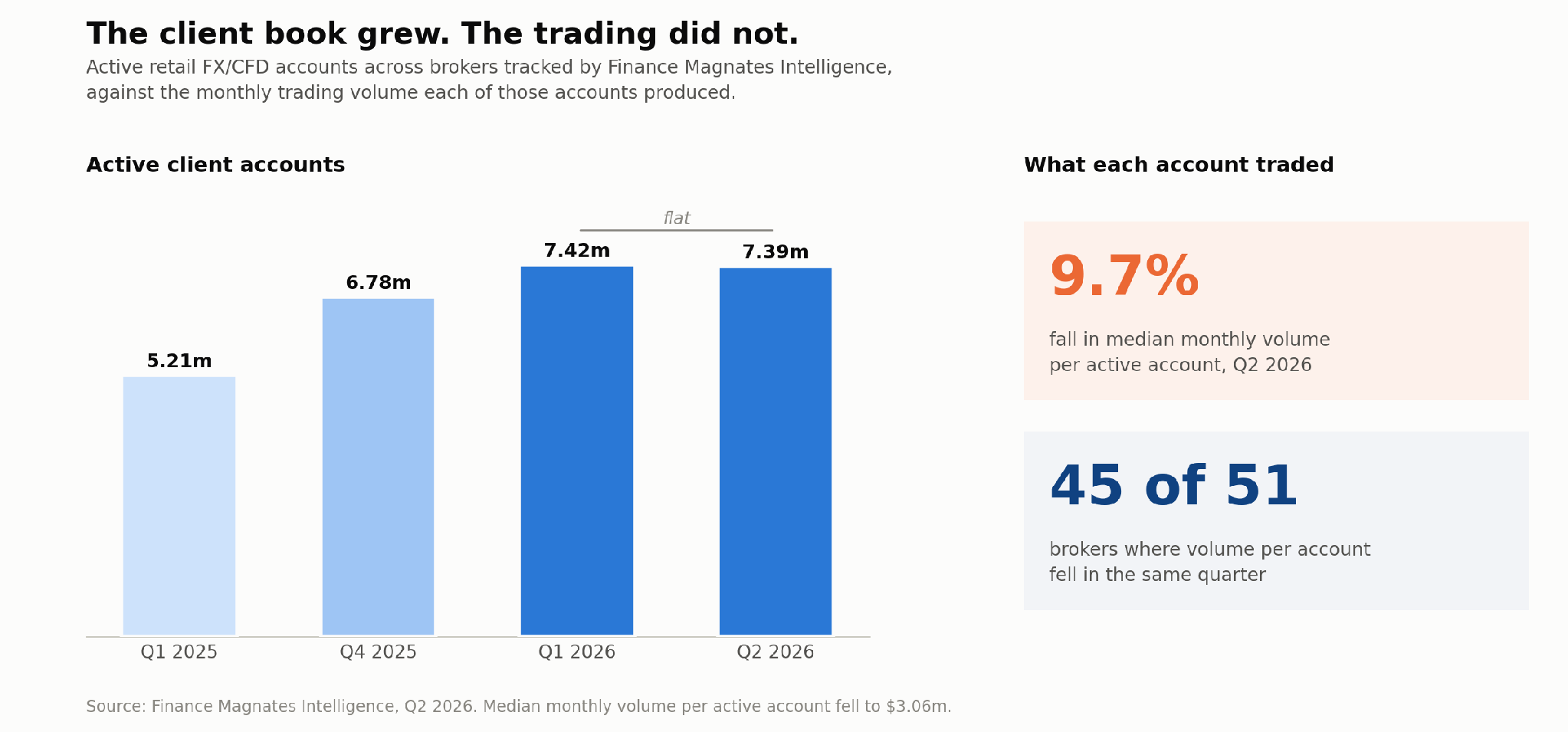
This is the number you need to plan around. Because now, a bigger client list doesn't guarantee more trading. Brokers kept buying accounts, and those accounts traded less.
Why does the pool of active traders refill so slowly? Because many traders lose money and leave. Across 14 FCA-regulated UK CFD brokers, 69.9% of retail accounts lose money on average (The Investor's Centre, 2026). As a result, 80% of retail day traders quit within two years, while only 7% are still trading after five years.
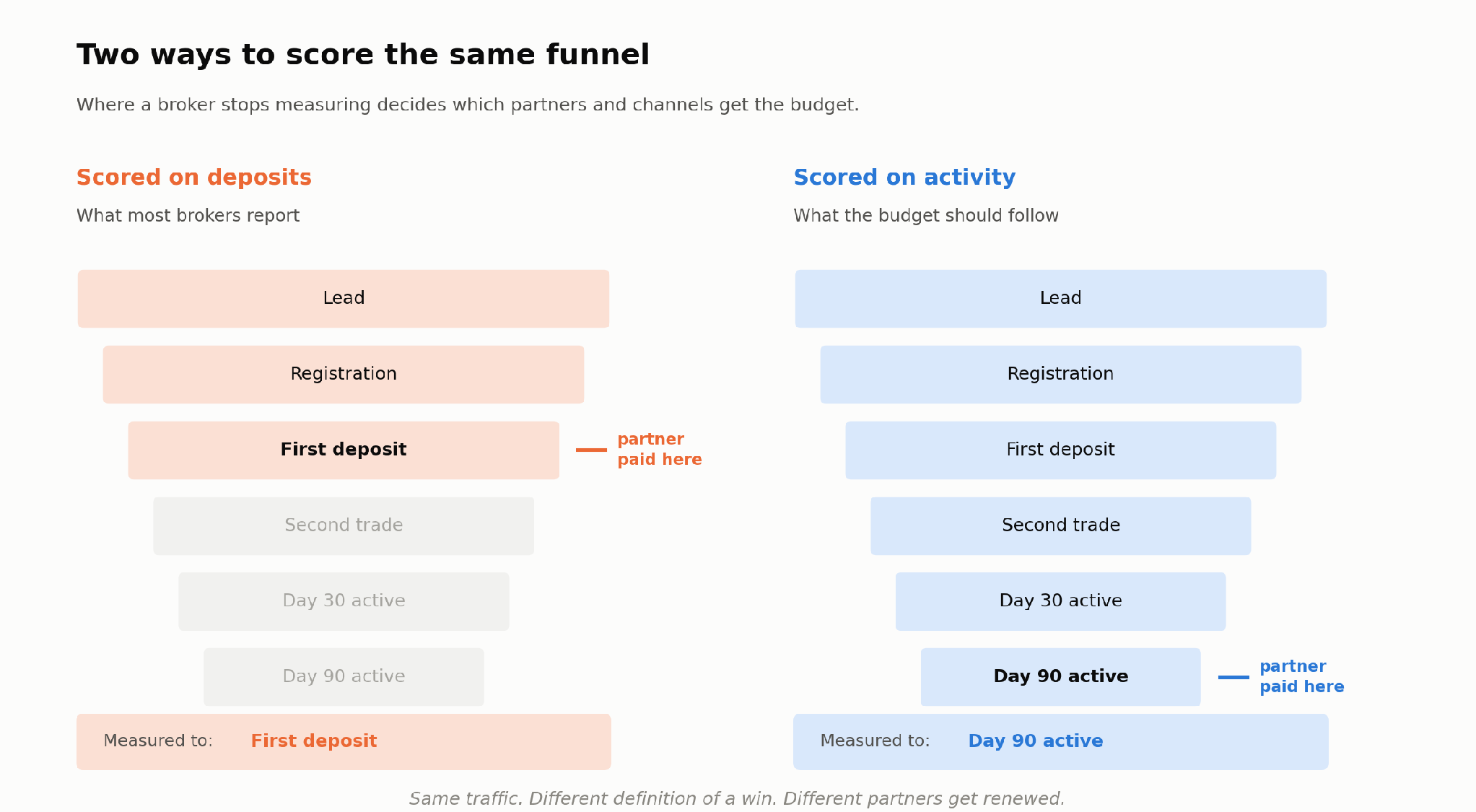
In the broker data, I have seen that this pattern follows how the broker defines a win. If you view a funded account as a win, you keep buying funded accounts, many of which go quiet in two years. But if you count a trade as the win, then your campaigns, onboarding, and partner deals - all start pushing towards a second and third trade. This article follows the second definition.
CFD Marketing Compliance Writes the First Draft of Your Brief
A broker planned a UK campaign last year and wrote the creative first. It built ad copy around high leverage, a deposit-match offer, and a countdown timer on the landing page, none of which could run. Since 2018, Deposit bonuses have been forbidden for retail clients in the UK, EU, and Australia, and the FCA rules caught the leverage claims a few weeks later. So, the campaign went back to the start before a single click was bought.
Here are five things to pay attention to before drafting a brief:
- Bonuses are banned: You cannot offer a retail client a deposit bonus, a cash incentive, or a rebate as a reward. ESMA's own temporary rules lapsed years ago, but national regulators made the same limits permanent (ESMA, February 2026).
- The rules keep spreading: On 24 February 2026, ESMA said that products sold as perpetual futures or perpetual contracts probably fall under the same CFD rules. If your 2026 plan perceives them as a way around those rules, it is not right.
- Risk warnings must carry your own numbers: Every ad has to show what share of your own retail accounts lose money. This includes short formats like social posts and banner ads (Track360, 2026). You cannot cite space as an excuse.
- What your affiliates post also counts as your advertising: The regulator holds the licensed broker responsible for what its partners say on its behalf.
- Google is a licence check: Google allows ads for CFDs, spot forex and spread betting only in listed countries, and only if you hold the right local licence and Google certifies your account (Google Ads policy).
Last year, the FCA led an action with nine regulators across six countries. It produced three arrests, more than 650 requests to take posts down, and over 50 website shutdowns (FCA, June 2025). In its July 2026 review, the FCA said it had issued 2,329 warnings about unauthorised or possible scam firms in 2025 (FCA, July 2026).
"CFDs are complex, high-risk products. The protections given to retail investors under our rules save UK consumers millions each year."
Mark Francis, director of sell-side markets, Financial Conduct Authority (FCA press release, 30 October 2025)
On the positive side, such protections make a difference. FCA rules stop almost 400,000 people annually from losing more than the money in their account, worth an estimated £267 million to £451 million. So, my view is simple: If you see compliance as the last check before launch, you will keep losing campaigns at review. But if you put it in the brief, then every next choice becomes easier.
How to Build a Forex Marketing Strategy Targeting Active Traders
Compared to previous times, the change is small but huge in impact. In simple words, you must judge every channel, partner, and campaign on whether the people it brings in are trading even three months later, or they didn't after their first deposit. This one change affects the budget.
Prioritise Partners Who Already Have Active Traders
More than 900 licensed brokers are chasing the same leads, and comparison sites make it easy for anyone shopping on price to switch (HotForexLead, 2026). The majority of the new retail clients still arrive through partners, so forex lead generation is mainly a question of which partners you sign.
An introducing broker program and an affiliate network do most of that work. An introducing broker is a firm or person who refers clients to you for a commission. This commission can be a flat fee per client, a share of the spread, a share of revenue, a rebate for each lot traded, or a combination of these.
The best programmes go a step further: They target trading educators, and signal providers and small fund managers whose audiences already trade weekly. A warm introduction from a partner like that is worth more than a large batch of cold display clicks.
Score Leads on Activity
A flat fee that pays out the moment someone makes a minimum deposit rewards the dormant-account problem as explained above. Once the deposit lands, the partner doesn't care what happens next.
Instead, you should use a mixed deal: A smaller fee up front, plus a share of revenue or a rebate per lot as the client keeps trading. Now, the partner earns more when their referrals stay active.
I have helped brokers rebuild partner programmes with this one change. It does more for lead quality than just adding another ad channel. You can see the shape of that work in Clickeon's broker case studies.
Use a Copy Trading Platform as an Onboarding Bridge
A copy trading platform lets a new client mirror an experienced trader's positions automatically. It gives them something to do, and something to learn from, before they feel ready to trade on their own.
In the onboarding flows I have watched, a client who follows an experienced trader for the first few weeks is still trading at the three-month mark far more often than one who is handed a login and left alone. So, you must use it as the bridge between the first deposit and the first trade they place themselves.
Personalise Onboarding by Trader Type
Onboarding is the point where trader retention is won or lost, and one email sequence for everyone can lose it. So, match the sequence with what the client told you at sign-up: their experience level and what they want to trade.
A first-time CFD trader and an experienced trader switching brokers need completely different things. The first needs to understand the risk before placing a trade. The second one needs a reason to move an existing setup across. Clickeon's forex and CFD marketing services build this kind of onboarding for brokers who would rather not staff it in-house.
What Trader Acquisition Costs in 2026
Forex client acquisition cost is the expenditure on marketing done to get one person to open an account and put money in. It determines whether the rest of your plan is affordable.
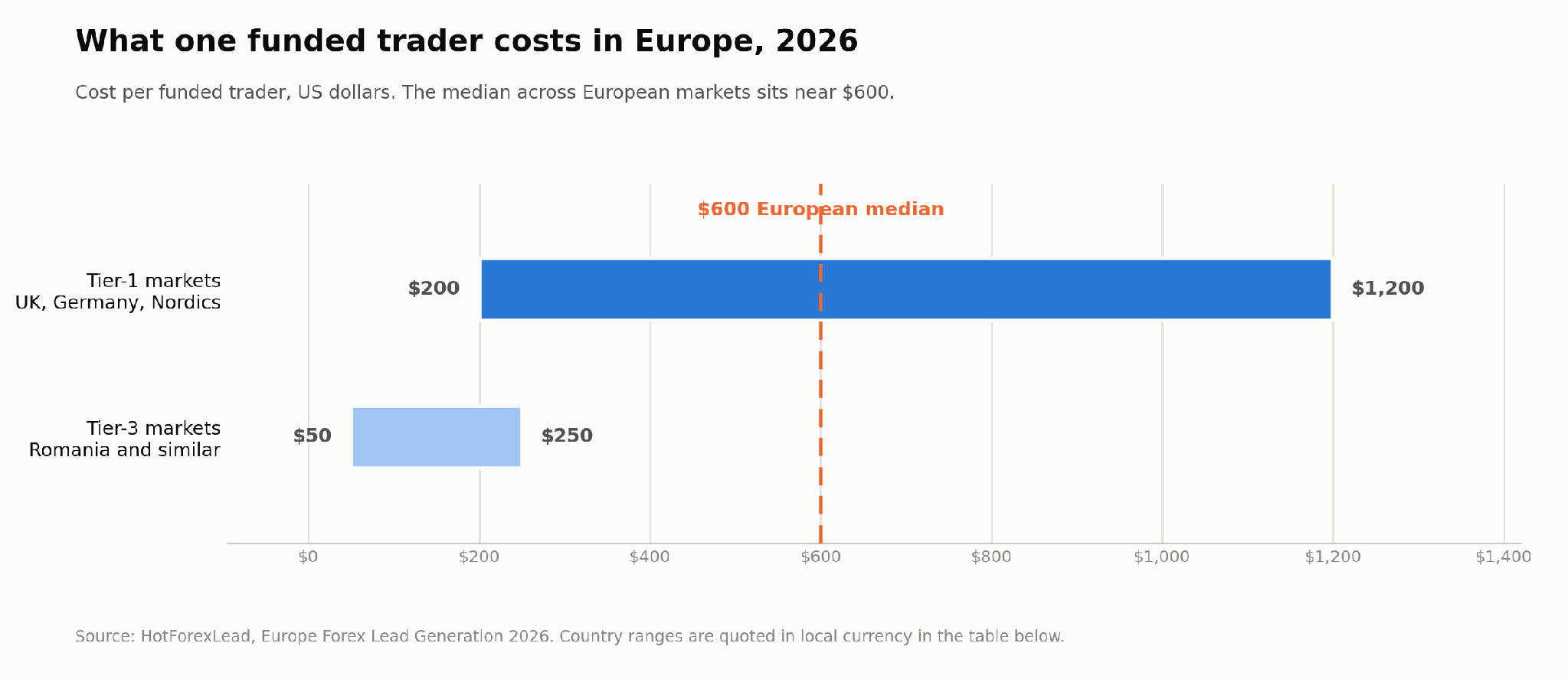
Across Europe, the typical figure is around $600 per funded client. In Tier-1 markets, with the largest and most competitive countries, it runs from $200 to $1,200. In Tier-3 markets, it falls to $50-250 (HotForexLead, 2026).
| Market | Typical cost per funded client, 2026 |
|---|---|
| United Kingdom | £400 to £1,500 per verified deposit |
| Germany | €350 to €1,200 per qualified first deposit |
| Nordics | €500 to €1,500 per verified deposit |
| France | €300 to €900 per first deposit |
| Poland (Tier-2) | €120 to €350 per first deposit |
| Romania (Tier-3) | €80 to €250 per first deposit |
Source: HotForexLead, Europe Forex Lead Generation 2026
If you put these costs next to the trading data, the problem becomes clear. In the UK or Germany, you may pay four figures for one client. But a dormant account is not a rounding error in the media plan anymore. Instead, it is a big waste.
So, the budget question for 2026 is not how many more accounts you can buy, but what a client who is still trading at three months costs you, and which sources produce them.
Common Mistakes That Waste Forex Marketing Budget
Why do forex marketing budgets underperform even when lead volume looks healthy? Three mistakes keep occurring in the campaigns I have reviewed, and there is no role of creative quality in this.
The first is measuring the whole funnel on first deposits instead of second and third trades. This fills the account book with people who never come back.
The second is treating compliance as the last step before launch instead of the first input to the brief. Later-stage campaign edits kill approved creatives and delay the launch.
The third is paying every partner the same rate, regardless of the quality of traders they send. A signal provider with an engaged following earns the same as a coupon site sending bulk traffic, so the program keeps buying the cheaper of the two.
Clickeon's work with VCG Markets in LATAM is a useful contrast. The change that improved the numbers was not a new channel. We re-scored the partner traffic they already had on three-month trading activity instead of deposit count, then shifted budget to the partners whose traders kept showing up.
The Bottom Line on Forex Marketing Strategy
The simple rule is to judge every channel, partner, and campaign on whether its traders are still trading after three months. And put compliance into the brief before the creative.
The market has already made this case. Account books grew all year and then stopped producing more trading. Brokers that keep chasing funded accounts will keep paying for this gap. If your reporting cannot tell you which channels bring in traders who stay active after three months, you must fix that before you try another channel.
Frequently Asked Questions
What is the difference between a funded trader and an active trader?
A funded trader has signed up and put in their money, whereas an active trader has placed a trade recently. In the second quarter of 2026, brokers tracked by Finance Magnates Intelligence held about 7.39 million active accounts, almost flat on the quarter. But the amount each account traded fell. So, there is nearly nothing that a steady account count can tell you about trading.
How much does it cost to acquire a forex trader in 2026?
Around $600 per funded client across Europe, from $200 to $1,200 in the biggest markets and $50 to $250 in the smallest. In the UK, the range is £400 to £1,500 per verified deposit. Three things increase these numbers even more: ad platform restrictions on CFD creative, weaker tracking after privacy changes, and the market of 900+ licensed brokers chasing the same leads.
Are deposit bonuses still allowed in forex marketing?
Not for retail clients in the EU, UK, or Australia. Cash and non-cash incentives were banned by rules that took effect in 2018 and are now permanent national law. ESMA restated those obligations in February 2026 and said perpetual futures probably fall under the same rules. Offshore-licensed brokers have more freedom, but they also have to follow the rules of any market they advertise into.
Is the introducing broker and affiliate channel still the best way to acquire forex traders?
For most of the brokers, yes! But the deals inside that channel have changed. Paying purely on deposit size rewards the dormant-account problem. A mixed deal and a smaller fee plus a share of what the client trades pays partners whose traders remain active. Remember that regulators see what your partners publish as your own advertising, so choosing a partner is as much a compliance decision as a commercial one.
Who is responsible if a forex affiliate breaks advertising rules?
The licensed broker. So, you must be very careful while choosing partners. Any forex affiliate marketing programme needs someone checking what partners publish. A 2025 action led by the FCA with nine regulators across six countries produced three arrests, more than 650 takedown requests and over 50 website shutdowns, and the pressure carried into 2026.
How long does it take to see results from a new forex marketing strategy?
The number that tells you whether the strategy works is how many of those clients are still trading after three months, and that takes a full quarter of data. So, you must judge a new forex marketing strategy on trading activity at three months.