
Key Takeaways
- Fintech buyers rarely decide alone: A B2B fintech purchase can involve 5 to 16 people across several departments. Your lead generation strategy therefore needs to reach more than one decision-maker.
- Signal-based outreach can bring leads faster: When you target prospects based on buying signals and combine that with compliant outbound, you can start seeing qualified leads in about four to eight weeks.
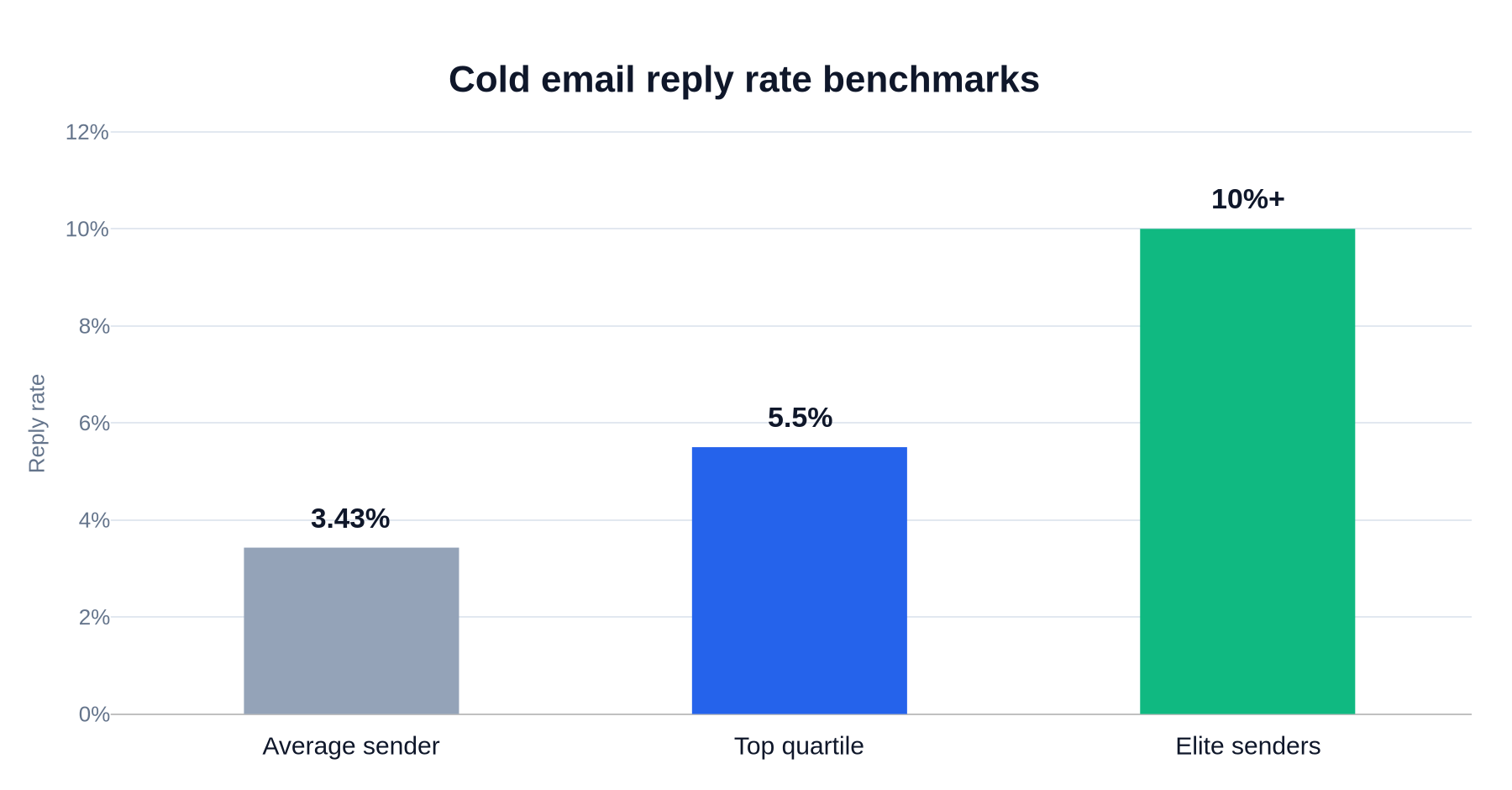
- Cold email still has a clear benchmark: The average reply rate is 3.43%. The top 25% of senders reach 5.5%, while the best performers can exceed 10%.
- Compliance affects where you can market: US email allows opt-out outreach under CAN-SPAM. The EU, UK, and Canada generally require consent before sending the first marketing message.
- Use several tactics at once: Some channels can bring leads quickly, while others take longer to build results. Running both at the same time gives you short-term leads without putting all your effort into one channel.
Table of Contents
- What Is Fintech Lead Generation?
- Why Fintech Lead Generation Is Harder Than Standard B2B
- Tactics That Produce Pipeline in Weeks
- Tactics That Pay Off in a Quarter or Two
- Tactics That Compound Over Months
- Fintech Lead Generation Tactics at a Glance
- The Bottom Line on Fintech Lead Generation
- Frequently Asked Questions About Fintech Lead Generation
Marketing teams selling into fintech usually arrive with a B2B playbook that has worked everywhere else. While most of it applies, the timeline doesn't. This is because a regulated buyer adds a review stage and a larger buying group to every deal, and the tactics themselves produce pipeline at very different speeds.
The 11 fintech lead generation tactics below are ordered by how fast each one works, from days to three quarters, so a team can run the quick ones and the slow ones simultaneously, some in sequence, and so on.
What Is Fintech Lead Generation?
Fintech lead generation is the process of identifying and engaging buyers at financial technology companies, then moving them toward a sales conversation. Banks, payment platforms, lenders, and insurers - all lie within regulated environments, which changes what you can claim and which channels are available.
The regulatory layer makes fintech lead generation quite different from generic B2B demand generation. A prospect evaluating a payments vendor has to satisfy a risk function, so proof of compliance handling does as much work as the pitch itself. Specialist support tends to beat a generalist B2B shop for that reason, which is why many teams work with a fintech marketing agency that already knows the review process.
Why Fintech Lead Generation Is Harder Than Standard B2B
Global fintech revenue reached $504 billion in 2025, up 22% year on year and growing more than four times faster than incumbent financial institutions (BCG, 2026). A larger market means more buyers, though it does nothing to make any individual buyer easier to reach.
Further, a fintech buying committee reliably adds a risk or compliance reviewer holding an effective veto, which is the seat B2B fintech marketing usually forgets to address until the deal is already in review. Gartner finds B2B buying groups now range from five to 16 people across as many as four functions, and 74% of buyer teams show what it calls unhealthy conflict during the decision (Gartner, 2025).
"Buying groups are more diverse than ever, ranging from five to 16 people across as many as four functions. Each member may have differing priorities and opinions."
- Delainey Kirkwood, Principal, Research in the Gartner Sales Practice, 2025
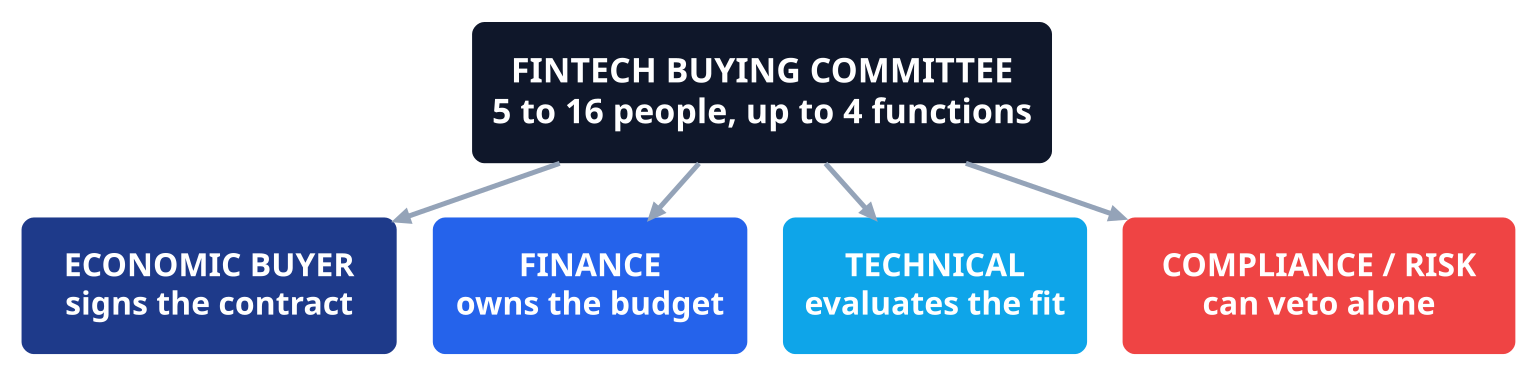
Standard playbooks assume a shorter path: find a champion and send a proposal. Fintech inserts a review stage that can end a deal in week ten over a question nobody asked in week one. Every tactic below is built for that: precision ahead of volume, and evidence that clears an audit.
Tactics That Produce Pipeline in Weeks
These five move fastest because each one either reaches a buyer already in a purchase window or improves conversion on traffic a team already has. You can expect first qualified leads within two months.
1. Signal-Based Targeting
A company that just closed a funding round, hired its first compliance lead, or announced a banking partner is spending money and is unusually receptive to a well-timed approach. So, signal-based targeting builds the prospect list from those triggers rather than from a static firmographic filter.
- Funding announcements: New capital creates budget and a mandate to deploy it fast.
- Compliance or payments hires: A first risk hire signals a company preparing to scale into regulated territory.
- Geographic expansion: Entering a new market forces a review of the existing vendor stack.
- Banking-partner changes: A switched partner puts every adjacent integration back in play.
You must route each hit to outbound within 48 hours, because competitors watch the same public signals and the advantage belongs to whoever reaches the account first. The window is short: a funding announcement draws vendor outreach for almost a fortnight before the inbox closes, and a new compliance hire is usually locked into a stack within their first quarter.
2. Compliant Omnichannel Outbound
Across billions of messages analysed through December 2025, the average cold email reply rate lies at 3.43%, with the top quartile at 5.5% and the strongest senders above 10% (Instantly, 2026). Fintech outbound has to beat that average while working within the rules that decide which channels are legal in each market.
In the United States, commercial email operates on an opt-out basis under CAN-SPAM, so prior permission is unnecessary, provided the message carries accurate headers, a physical postal address, and a working unsubscribe honoured within ten business days. Each violating email carries a civil penalty of up to $53,088 (FTC). The EU, UK, and Canada work the other way, requiring consent before the first commercial message.
So, you must develop the channel mix by region before writing sequences. Calls and LinkedIn outreach remain available across all three regimes, so an account list spanning Europe and North America needs two different sequences rather than one translated twice.
3. Paid Social by Decision-Maker Title
Paid social reaches a fintech audience when targeting runs on job title and company list instead of interest category. A filter for VP of Finance at a named set of 200 payment companies doesn't behave like an audience interested in financial technology.
You must see it as an awareness layer beneath outbound and account-based marketing. The objective is recognition, so that a cold email arriving three weeks later lands with a company the prospect has already seen. So, you can budget it to stay visible against a defined account list rather than to close on its own.
4. Lead Magnets and Interactive Tools
A lead magnet trades gated content for a work email. In fintech, the versions that convert solve a narrow calculation the prospect was going to run in a spreadsheet anyway: a compliance cost estimator, an interchange-fee calculator, or a vendor-comparison checklist.
So, keep the gate light. You can ask for a work email and company name, then deliver the result on the spot rather than promising a follow-up. Someone who extracts actual value in 30 seconds remembers who built the tool, while a five-field form ahead of any value can lose them.
5. Landing Page Conversion Optimization
A page converting at 2% where 4% is achievable has more of a page problem than a traffic problem. In campaigns we have run for fintech clients, the change that moved conversion furthest was usually cutting form fields from seven to three, ahead of any redesign.
So, you should test one variable at a time, whether that is the headline, the form length, or the proof element above the fold. Run each test for two weeks or until it reaches significance, whichever is longer, and log what shifted the number.
Tactics That Pay Off in a Quarter or Two
These four take longer to stand up because each depends on assets or relationships that need to be built first. They also carry a deal through the review stage where fast tactics stop helping.
6. Account-Based Marketing for the Whole Committee
Given a buying group of five to 16 people, selling to one champion and trusting them to carry the deal internally is how a fintech sales pipeline stalls in review. Account-based marketing perceives the committee as a unit of sale.
Ideally, you should map every likely stakeholder across finance, compliance, technical evaluation, and the economic buyer before outreach begins, then run role-specific messaging to each instead of repeating one pitch five times. Coordinating that across channels is the kind of campaign orchestration work that keeps account-based marketing viable beyond the first two accounts. The setup cost generally justifies itself once annual contract value clears five figures.
7. Proof Assets
A case study carrying real numbers moves a fintech deal further than another product demo. When building sales enablement for forex and crypto clients, the compliance reviewers ask for evidence first: a named client, a specific result, and proof the vendor has operated within a regulated environment before.
- One detailed case study: A named client and a measurable outcome, rather than a percentage without attribution.
- A one-page compliance summary: SOC 2 status, data residency and uptime, written for a reviewer rather than a buyer.
- A page of verified reviews: Third-party and attributable, since self-reported praise carries little weight in reviews.
Finally, you must link all three from every outbound email and every gated asset, because buyers forward them internally long before booking a call. Our own client case studies follow that shape: Exness, IUX, and VCG Markets lead with a named result.
8. Webinars and Industry Events
A 30-minute session with an actual person answering unscripted questions remains one of the few formats a compliance-cautious buyer will attend before speaking to sales. This willingness makes webinars durable while most B2B content has moved to shorter formats.
You must choose one narrow problem per session instead of an industry overview, and require a work email at registration so the list doubles as a mid-funnel pool. Then, follow up with attendees within 24 hours, and treat no-shows as a separate segment.
9. Referral and Partner Programs
A referral arrives with the trust transfer already complete, which is why these consistently produce the shortest sales cycles of anything here. The cost is lead time, since a programme takes a quarter or two to systematise.
You must run two motions at once: a customer referral programme with a defined incentive, and a technical integration-partner programme with companies whose product lies beside yours in a client's stack. The second compounds, because each new integration partner brings its own customer base within reach.
Tactics That Compound Over Months
Both take three to nine months to produce measurable pipeline, and keep producing long after an outbound push slows down. The compounding is genuine but slow, which makes them easy to defer whenever quarterly targets are under pressure, and the outbound numbers look more urgent by comparison.
Deferring them is the most common sequencing mistake in fintech lead generation.
10. Founder-Led LinkedIn Content
A company page posting product updates reads as marketing. A founder describing a real customer problem and how the product addressed it reads as insight, and a sceptical buyer forwards this insight to a colleague.
The format that works is specific: one real problem, one concrete fix, and one number attached to the outcome. Announcement posts get scrolled past by the finance and compliance audiences that are worth reaching.
11. Trust-First Content Built for AI Search
Content written to be cited by an answer engine leads with the answer, states the source, and stops, which happens to be the structure a compliance officer wants when checking whether a vendor's claims hold up.
"B2B leaders must embrace a more disciplined and evidence-driven approach to how they engage with generative AI, prioritizing trust and tangible value for buyers as they head into next year."
- Sharyn Leaver, Chief Research Officer at Forrester, 2026 B2B predictions
You must structure every piece around one question per section, answer it in the opening sentence, and cite the figure or regulation behind it. Google and the AI answer engines reward that now, and it shortens the distance to trust for a buyer arriving sceptical.
Two things do most of the work here: date every statistic so a reviewer can judge whether it still holds, and name the regulator or study rather than gesturing at research. Both make a passage quotable in isolation, which is the unit an answer engine picks, and both pass the compliance read that decides whether the claim can appear in a deck.
Fintech Lead Generation Tactics at a Glance
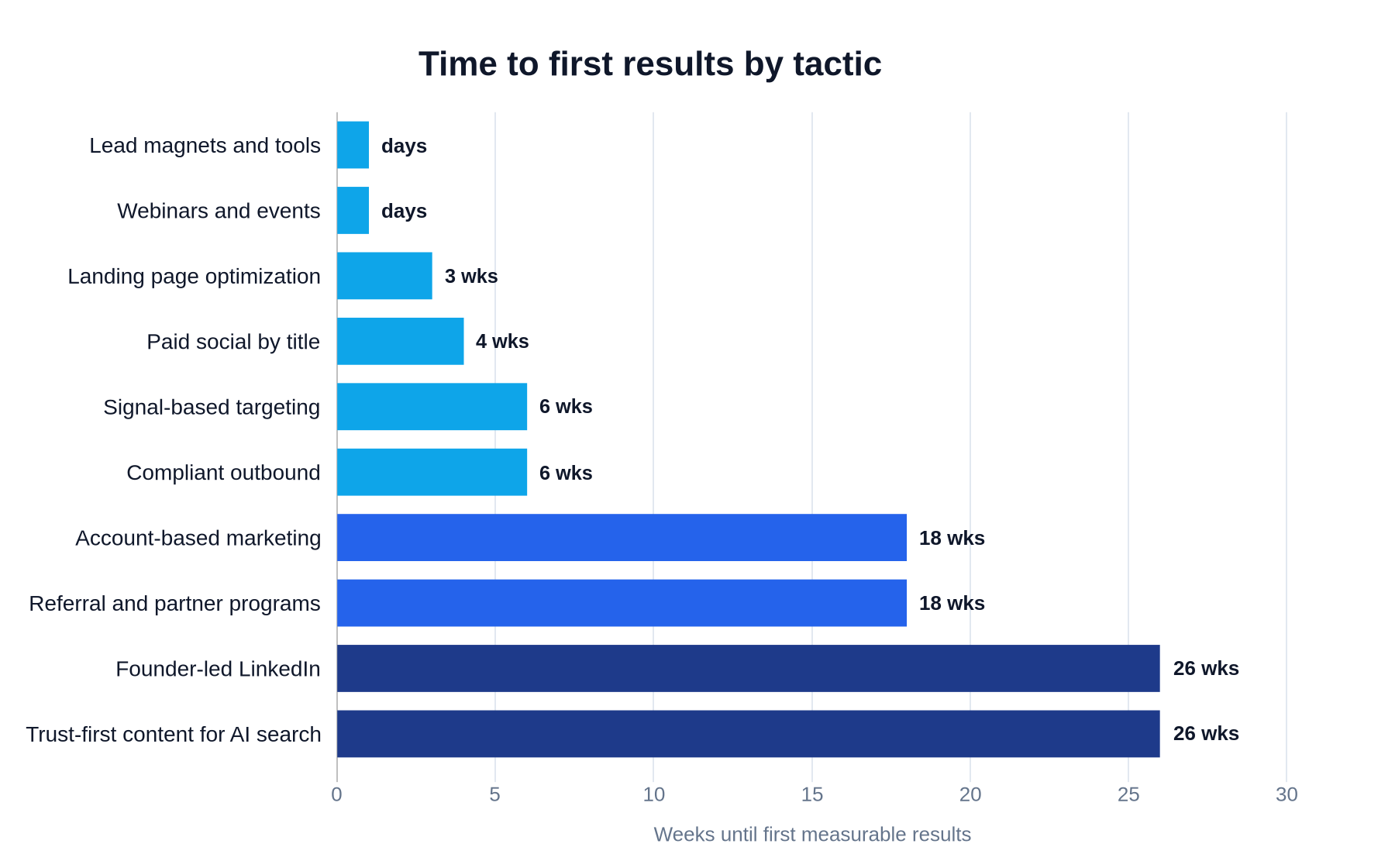
Time to first results varies enormously across these 11 tactics, which is why sequencing matters more than choosing a favourite. The ranges below reflect typical execution timelines across fintech and forex campaigns.
| Tactic | Time to first results | Best for |
|---|---|---|
| Compliant omnichannel outbound | 4-8 weeks to first SQLs | Fast pipeline against a defined ICP |
| Signal-based targeting | 4-8 weeks, compounds with outbound | Precision ahead of volume |
| Paid social by title | 2-6 weeks to build awareness | Warming accounts before outbound |
| Lead magnets and tools | Days to launch, ongoing capture | Top-of-funnel opt-ins |
| Landing page optimization | 2-4 week test cycles | Converting existing traffic |
| Webinars and events | Days per event | Compliance-cautious buyers |
| Account-based marketing | 1-2 quarters | Enterprise deals, 6+ stakeholders |
| Referral and partner programs | 1-2 quarters to systematise | Lower CAC, warm introductions |
| Proof assets | Ongoing, supports everything above | Shortening review-stage delays |
| Founder-led LinkedIn | 3-9 months, compounding | Building category trust |
| Trust-first content for AI search | 3-9 months, compounding | Inbound and AI citations |
Typical time to first results by tactic, based on execution timelines across fintech and forex campaigns.
The Bottom Line on Fintech Lead Generation
A fintech lead generation strategy works when precision beats volume. Signal-based targeting and compliant outbound produce pipeline within weeks, proof assets and account-based marketing carry that pipeline through a compliance review, and trust-first content compounds into inbound over the following two quarters. Running all three layers together separates tactics that convert from activity from those that merely look busy.
The sequencing question is usually where teams get stuck, since the fast tactics and the compounding ones draw on different budgets and different people. If you are weighing which of the 11 to start with, talk to our team.
Frequently Asked Questions About Fintech Lead Generation
How many decision-makers are involved in a fintech deal?
Gartner puts a current B2B buying group at five to 16 people spread across as many as four functions. A fintech purchase typically pulls in a finance lead, a compliance or risk reviewer, a technical evaluator, and the economic buyer who signs. Any one of them can pause a deal the others have already approved, which is why single-champion selling stalls so reliably.
What is a realistic cold email reply rate for fintech outbound?
Around 3.43% is the current average across billions of analysed messages, with the top quartile at 5.5% and the strongest senders above 10%. Clearing 5% puts a campaign ahead of most B2B senders. Relevance drives that number far more than volume does, so a tightly targeted list of 200 accounts will usually outperform a generic send to 2,000.
Which fintech lead generation tactic produces results fastest?
Compliant outbound and signal-based targeting typically deliver first sales-qualified leads within four to eight weeks. Content, SEO, and AI-search visibility need three to nine months to compound, then keep producing after an outbound push slows. The majority of teams get the best outcome running both from the start instead of treating the slower work as a phase-two project.
Is cold email legal for fintech companies targeting Europe or Canada?
The opt-out model permitted in the United States does not transfer. The EU and UK require consent under GDPR and PECR before commercial email, and Canada's CASL works the same way. Outreach into those markets should lean on calling and LinkedIn, both of which remain available across all three regimes, with email reserved for contacts who have opted in.
Should a fintech startup outsource lead generation or hire in-house?
Outsourcing is usually faster and cheaper before an ICP is validated, since it avoids the fixed cost of an SDR team while messaging is still moving. Once targeting holds up, an in-house team tends to earn its keep through deeper product knowledge and quicker iteration. Most of the teams reach that decision somewhere around their first ten closed deals.
What makes fintech lead generation different from general B2B lead generation?
A regulated buyer changes three things: which claims the first contact can make, which channels are legally available in each market, and how much evidence a deal needs before it clears review. Generic B2B tactics still work mechanically, though they underperform when a compliance seat enters late and asks for proof the campaign didn't produce.